--------
Art is a vital aspect of human life. We see it in ancient history, in today’s culture, and even projected in the future. Art is pervasive in the everyday; often times we overlook it or do not appreciate all the forms in which it presents itself. Even those things that we do not generally think of as art are art forms in and of themselves. When we do something as simple as walking down the street, we are surrounded by art – graphic art, written art, musical art. Whether it is a billboard, a mural, or a song does not matter; it is still art. Whether it is meant for entertainment, advertisement, or just personal enjoyment is irrelevant. It is still art. A quick consultation of the dictionary confirms this. Art is defined two different ways in the American Heritage Dictionary. First, it is the “human effort to imitate, change, or counteract nature.” The second definition is more specific to what we think of as art: “The creation or production of something that is considered beautiful, as in painting, sculpture, poetry, or music.” According to this definition, something must be beautiful in order to be considered art. Is this really the case? That is just one of many questions we will examine here. The working definition of art, for the purpose of this paper, will not only mean things like paintings and sculptures. Instead, it will embody every type of visual and oratorical communication – whether it be a Rembrandt painting in a National Gallery, or a logo on a pair of jeans. This classification of art may seem quite vague; while that may be, it is necessary to look at all types of art in order to fully appreciate and understand how art as a whole plays into things like history, society, and psychology. Those things are generally not associated with art – however, through this paper it will be shown that art plays a significant role in all aspects of life. We will be examining art, but not only in the classical sense. Because art relates to every aspect of life, we will look at art and beauty in relation to and in light of history, ethics, philosophy, biology, psychology, sociology, economics, politics, law, and finally theology. To give this examination some context, I would argue that art and beauty are fairly subjective; that is, whether something is “good” or not, in relation to art, is left almost entirely up to an individual’s taste. On the other hand, there are several objective truths that would determine whether a subject is art or something else. This idea will appear in several of the topics discussed. One could look at this paper as a sort of Sparknotes for Art. We will look into a little bit of everything about the subject, and come out having learned something and with some thoughts to think about.
In order to understand any subject to its full extent, one must first look at how it relates to history, and art is no exception to the rule. The best way to appreciate the modern visual and communicative art is to understand how it has developed over time. Marcia Pointon, a prominent author on the subject, says in her book The History of Art that, “all [art is] determined by how we live and interact with our environment now, as well as by what happened in the past.” Therefore, the question of where art originated is (obviously) a key part to the history of art. When one thinks of the oldest type of art known to man, one’s mind might travel to cave paintings. These are, after all, equivocated with some of the earliest people groups, but even cave paintings cannot correctly be labeled as the earliest art known to man. Michel Lorblanchet, a French archaeologist who specializes in studying the production of cave paintings, was quoted saying, “The very concept of the ‘birth’ or ‘origin’ of art may seem inappropriate, since humans are by nature artists and the history of art begins with that of humanity. In their artistic impulses and achievements humans express their vitality, their ability to establish a beneficial and positive relationship with their environment, to humanize nature.” Essentially, Lorblanchet is giving the same definition to art as it was given in the beginning of this paper: the human effort to imitate, change, or counteract nature in the form of something that is beautiful. With a definition such as this, one can only conclude that art has existed as long as humans have. Although Lorblanchet is a staunch evolutionist, and as such believes that humans came into existence millions of years ago, one can assent to his statement regardless of the worldview he holds. Logically, art came into existence the moment humans first worked at anything.
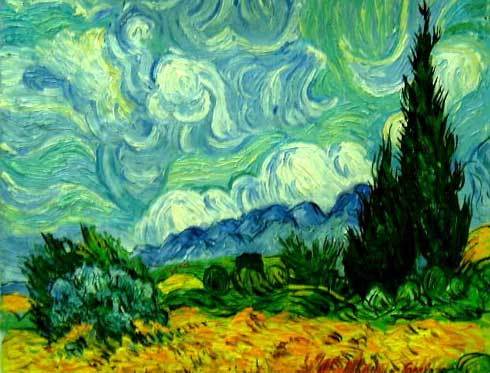
The history of art and its development can be clearly categorized and identified into different time periods, especially in reference to paintings, sculptures, and architecture. According to the Art History Guide, the first of these time periods is from 3000 BC onward; these were the ancient civilizations, and included Egyptian, Greek, and Persian art. Next came the classic civilizations with Roman art and Hellenistic art, from around 800 BC to 300 AD. With the art of the Middle Ages came more religious themes, with Islamic art and the Gothic style. These themes continued into the Renaissance, from 1400 to 1800 AD. The Renaissance included the Baroque and Rococo periods, and occurred all throughout Europe. In the 1800s there began an era of art known as the ‘pre-modern’ era. This included famous and favorite styles like romanticism, realism, and impressionism with artists like Picasso and Van Gogh. After that came the Modern area, from around 1880 to 1945, with the expressionism of Marc and the surrealism of Dali. From 1945 on came the development of modern and post-modern art. This time, art was not limited to paintings and sculptures; the post-modern era has art categories like computer art, performing arts, and pop art (music). All through this history and development of art, we see one theme retained: It is all a creation and representation of beauty and the natural world, just coming through different forms throughout the various styles and periods.
Next is the discussion about the ethics of art. The question that may be asked to embody this discussion is: Does art have a morally objective nature, or is it merely subjective? There have been many different takes on this throughout the years. More recently developed is a movement called aestheticism. According to the Britannica, aestheticism is “the late 19th-century European arts movement which centred on the doctrine that art exists for the sake of its beauty alone, and that it need serve no political, didactic, or other purpose.” This movement actually divorced art from morality, claiming that the autonomy of aesthetic standards are set apart from considerations of morality, utility, or pleasure. With this view of art, anything created and called art by the artist would be right and beautiful – one could not fairly call it wrong or immoral, because it exists for the sake of its own beauty. In March of 1888, the North American Review published an article entitled “Art and Morality”, by Robert Ingersoll, a prominent political and social figure at the time. Ingersoll’s views conformed exactly with the aesthetic movement. In the article, Ingersoll says, “Of course there is no such thing as absolute beauty or absolute morality. We now clearly perceive that beauty and conduct are relative.” Later in the same article, Ingersoll goes on to say that “Art has nothing to do directly with morality or immorality. It is its own excuse for being; it exists for itself.” In reference to how the beauty or goodness of a piece of art is determined, Ingersoll concludes that “The soul -- that is to say the artist -- compares the pictures in its own brain with the pictures that have been taken from the galleries of others and made visible. This soul, this artist, selects that which is nearest perfection in each, takes such parts as it deems perfect, puts them together, forms new pictures, new statues, and in this way creates the ideal.” The idea that beauty and art is subjective is relatively easy to accept – some individuals like classical music, while others favor the modern developments of hard rock or rap. How could one logically argue that one of these styles is better than the other? It just cannot be done. So, to a certain extent, art and beauty really is subjective, and based on personal preference. Keep in mind, however, that it is only to a certain extent. When one likes hard rock rather than Mozart, he is not necessarily claiming that classical music is not art – rather, it merely does not correspond to his personal preference. Given this thought, one might still ask: Are there any attributes that make an object or creation objectively beautiful? What if there is an objective beauty and personal aesthetics? The view of beauty before the aesthetic movement was much more objective – either a thing was beautiful or not, regardless of an individual’s emotional response to it. C.S. Lewis discusses the issue of aesthetics in great length in his essay Men Without Chests. In the essay he makes it quite clear that, “Until quite modern times all teachers and even all men believed the universe to be such that certain emotional reactions on our part could be either congruous or incongruous to it – believed, in fact, that objects did not merely receive, but could merit, our approval or disapproval, our reverence or our contempt.” Given these two differing views, it is possible to arrive at a midway point. That is to say that objects (both made and in nature) have objective qualities within them that reflect their beauty, and that one’s personal preferences reflect nothing on the nature of the object itself, only on the feelings and responses of the individual.
The discussion of art (as defined in this paper) relates directly to philosophy. Philosophy deals not only with issues like existence and the origin of the universe; it is much broader and covers a wide range of subjects. Philosophy is the study of general problems concerning matters such as knowledge, truth, beauty, justice, validity, mind, and language. It does not seek to address specifics – instead, it addresses the wide theories and ideas behind a given subject. As such, many philosophers had a great deal to say about the nature of beauty (and, in effect, art). Aristotle and Plato both had the same view towards how humanity determines beauty. That is, that education serves as the means of imparting into young people what is good and bad, or pleasant and disgusting in the area of morality, philosophies, and (surprise) aesthetics. According to Aristotle, imitating nature constitutes art. In other words, something that does not imitate nature cannot be classified as art. Aristotle was the first to introduce this theory. He went even further, presenting three methods for classifying art based on the idea of art as imitation. The first method involves a difference in the means of imitation. In the first chapter of Poetics, Aristotle wrote, "Just as color and form are used as means by some . . .and the voice is used by others; . . .the means with them as a whole are rhythm, language, and harmony." Examination of the object being represented is a second way to classify art. Aristotle made a distinction about the motive of the action being imitated. He wrote in Poetics, "It follows, therefore, that the agents represented must be either above our own level of goodness, or beneath it, or just such as we are;" In this way, Aristotle introduced the idea of virtue as a factor in the object of imitation.
What of the philosophy surrounding the objectivity of art? C.S. Lewis quotes both Aristotle and Plato in his discussion on the topic, saying that, “Aristotle says that the aim of education is to make the pupil like and dislike what he ought. When the age for reflective thought comes, the pupil who has been thus trained in ‘ordinate affections’ or ‘just sentiments’ will easily find the first principles in ethics; but to the corrupt man they will never be visible at all and he can make no progress in that science.” Continuing, Lewis brings Plato into the discussion. “Plato before him had said the same. The little human animal will not at first have the right responses. It must be trained to feel pleasure, liking, disgust, and hatred at those things which really are pleasant, likeable, disgusting, and hateful.” This philosophy does not necessarily take away from the objective quality of beautiful and good things; instead, it merely states that humans must be trained to recognize what really is beautiful. According to Aristotle, the quality of the object produced determines the merit of the art; art is found within the product, not within the mind of the artist. Naturally this theory is inconsistent with the aesthetic movement and the theory of most modern philosophers – that art is more subjective to the viewer or the artist, rather than objective. Regardless of which philosophy is accepted, the study of art through philosophy is still a very important aspect in the discussion of aesthetics and beauty. While other areas may look at the specifics of different types of art, or at which kind of art is acceptable, philosophy for the most part deals with the big picture; the most fundamental question of, What is beauty? It is only once that question is answered that one may begin to examine different styles and time periods to determine their beauty and worth.
Perhaps the most unexpected topic covered in this paper is biology, and it’s relation to art. The subject of biology in relation to art means only the scientific applications to art, and the artistic applications to science. On the surface it may not seem as if these two topics are even remotely related; however, there has been (recently, especially) a great interest in the relation between the two. F. David Peat, an author and physicist, has these questions to ask of the newly developing relationship between art and science: “Recently this has become a highly fashionable topic with a number [of] Art and Science conferences and exhibitions being held, as well as funding being offered for individual collaborations. Is this evidence of a new spirit? A second Renaissance? Or is it merely the latest fashion? Is art and science involved in a true marriage, or simply a fleeting series of illicit relationships? Indeed, should such a marriage be arranged, encouraged and fostered, or is it more creative when individuals simply find each other and collaborate in idiosyncratic ways?” These questions are important to the art-science interface. Professor Chris Isham, a theoretical physicist, indirectly answers Peat’s questions. He says that, “When thinking of potential links between Science and the Visual Arts, certain ideas arise at once. For example, the physiology and psychology of vision; the physics of light; the physics and chemistry of materials used in artistic products, etc.” Here Isham is talking about the actual way that nature itself interacts with and is necessary for art. He goes on to talk more about the relationship between the study of science and art, saying that, “There is also Science considered as a source of subjects for artistic inspiration of metaphors and analogies; and then there is Art put to work as a tool in the exposition of science, especially the biological and medical sciences. Certainly, there is no doubt that individual artists and scientists can benefit from meeting each other and, perhaps, acting to stimulate each other’s ideas and to enhance each other as individuals.” A very strong and healthy relationship has developed between these two very different objects of study, and it is hoped that science will further art, and vice versa, in the very near future.
A subject that art has a strongly obvious and direct relationship with is psychology. To a certain extent there is no discipline or ‘official’ study for "the psychology of art," because there are few psychology of art programs in the universities. However, the literature on the topic is extensive, given that the issues addressed by art psychology have attracted both professional psychologists as well as non-professionals; it has attracted those who write about the arts, including music and architecture, and those who produce it. This relationship (the “Psychology of Art”) is a ‘two way street’, so to speak; the mind creates art, and the created art can in turn affect the mind (or, so many believe). From purely scientific standpoint, there are different parts of the brain that create and affect art. The two broadest ‘departments’ in the brain are left and right brain. The right brain controls things like patterns, intuition, and sensory input, while the left brain deals with logical, language, and analysis. Though the right brain is the creative side, making art (whether it is music, painting, or language) requires both left and right brain. For example, when you start a painting, you need be able to visualize the final painting in your mind (right brain, working from the whole), then develop the painting, choosing the elements, matching and mixing colors, placing in the shadows and highlights (right brain, working on various things simultaneously), but at the same time be able to look critically at what you've doing (left brain, being analytical).
But what about art’s affect on the mind? Through various modes of art we can see a clear reciprocal in the relationship. Perhaps the clearest we can see art’s affect on the brain is through the mode of music. Boethius, a Roman scholar and philosopher, puts great emphasis on the power of music. He said that, "Music is so naturally united with us that we cannot be free from it even if we so desire”, and that, “Music is part of us, and either ennobles or degrades our behavior.” Music has a strong affect on our mind; our attitude, our choices, and our behavior. Boethius makes it clear that this affect can be either good or bad; it can ennoble or degrade. Daniel Levitin, a former producer and current cognitive psychologist, has a great deal to say about the subject. Levitin worked for 15 years as a sound engineer and record producer. Today, after receiving a Ph.D. in cognitive psychology, he heads the Levitin Laboratory for Music Perception, Cognition and Expertise at McGill University in Montreal. Levitin shares what he has learned in his book, This Is Your Brain on Music, in terms that non-musicians and non-scientists alike can understand, answering questions like: Why is it when we hear music we often want to get up and dance, or at least tap our toes? In the book, his response is that, "For reasons that aren't entirely understood yet, music is wired to the motor areas of the brain. When music hits our eardrums, part of the signal flows up toward the motor cortex and creates a connection." That part, the motor cortex, is the same part of the brain that helps us move in a willful way, for example, to jog or type. So, although it is not entirely known how or why music and art affect human psychology, science has most definitely shown that it does.
Art is influenced by many different factors; perhaps one of the most affective is society itself. And, as with psychology, it is a reciprocal relationship – that is, art has a large affect on culture. Today we are constantly surrounded by the arts (even if the things we see may not commonly be thought of as art). In The History of Art, Marcia Pointon shows just how inundated today’s culture is, saying that, “Those of us who live in Western-style societies inhabit a world of visual communications: television, films, videos, advertisements, traffic signs… graffiti on buildings and vehicles, photographs in newspapers, paintings in galleries, serial strips and cartoons, [even] the packaging on consumer goods.” The ‘art’ that surrounds us ranges from advertisements on a billboard to fine art in an art gallery. In this way, everyone is affected in one way or another by the arts. But how many Americans actually make an active effort to be involved with the arts? The United States Census Bureau found that the national average of these kinds of activities were actually quite low. It reports that, in a given year, an average of 26.5% adults visited an art museum or gallery, 33.4% attended arts fairs or festivals, and only around 10% attended some sort of musical concert at least once throughout the year.
Of course, society can affect the arts and one’s taste in art as well. Levitin (the cognitive psychologist) says that, "The music culture that you are raised in forms the foundation for the kind of music you can understand, like a language.” Society or culture plays a large role in shaping one’s preference in the arts. Levitin goes on to say, "...if you hear American or European music based on Western scales as an infant, that's the music you are going to like, as opposed to Pakistani music or Indian music or Chinese opera." This is clearly shown in the area of music, especially. For instance, take two musical artists: Mozart and Bono, from the band U2. They each play extremely different styles of music: one classical, the other rock. It is the society that they lived in that determined what type of music they played. Mozart lived and composed in the 18th century, while U2 is a modern band. While it is interesting to note that Mozart is still extremely popular, one can still see that musical tastes and styles are affected by which culture or time period one lives in.
In terms of the economy, there is no doubt that the arts generate a large amount of money; this is through record albums, concerts, movie theatres, and stage plays, to name a few. Even though the arts make up a large part of the American economy, it is nevertheless difficult to make a living as a specialized artist. In May, The Washington Post published an article entitled “Art Students’ Predicament: Special Skills but Limited Prospects”. In the article, the Post recounted story after story of art students who, even though they have the proper training, are worried about their future after college. The article worried, “As many undergraduates fret about graduation, at least one subculture of students in the expensive college landscape is exuding a decidedly morose state of mind: art students. Like many undergrads seeking specialized humanities degrees, student artists wonder what viable place they can occupy in a tightening economy, which now is luring young people into more stable careers in government, the sciences, health care or consulting.” Especially with the state of the economy today, there is a great concern for artists. Nationwide, however, this generation of student artists, motivated primarily to work in multimedia careers, doesn't seem to care about the long odds. For example, among more than 30 private art schools, applications shot up 5 to 10 percent from 2002 to 2007, according to the Association of Independent Colleges of Art and Design. Additionally, Richard Freeman, a Harvard professor and National Bureau of Economic Research director, said young artists can take comfort: Young bankers are almost on par with them in choosing risky careers. Even though entering a career as an artist may be risky in today’s economy, there are still a plethora of career choices for an artistic person. Marion Boddy-Evans, an artist, writer, and photographer based on the Isle of Skye in Scotland, says, “A career in art is not limited to being a painter of canvases which get framed and sold in a gallery. Behind every piece of art in a newspaper, magazine, book, poster, and leaflet there’s a graphic or commercial artist -- usually a team. There are graphic artists putting the magazines together, illustrators drawing the cartoons and graphics. Website designers, computer-graphic artists, and animators. Film, TV, and stage set building. Computer games. Art galleries and museums. Teaching art and art therapy. Mural painting and face painting.” She then goes on to think of more broad careers that could be pursued by an artist: “Photography, landscape design, interior design, shop-window design, framing. Textile and clothing design. Furniture and lighting design. Architecture and engineering. These all require creative skills and, even if in your heart you long to be a fine artist, working in any of these fields will complement what you do at your easel in your 'own' time.” Economically speaking, the arts have a wide range of opportunities. Unfortunately, in recent days, the rest of the economic status has limited these opportunities; hopefully soon things will be returned back to the status quo, and the arts will continue as an economic majority.
Two areas of discipline that overarch almost every aspect of life (including the arts) are politics and law. They both run hand-in-hand; essentially, the politics around any given object creates the law concerning it. The politics (and, consequently, the law) surrounding art vary greatly culture to culture, and country to country; for that reason, for the purpose of this paper, only American law and politics will be examined.
Almost all laws dealing with the arts are laws that limit the production and/or distribution of the product. Artistic expressions that are commonly limited in America include song lyrics, photographs, advertisements, and pornography. The most fundamental (and famous) law concerning these limitations is found in the Constitution – the First Amendment. This ultimately protects the freedom of speech, and has been expanded to include the protection of artistic expression. Contrary to the perception of many, the First Amendment does not guarantee the right to express whatever we want, whenever we want. While the American government cannot limit or control artistic expression, it can regulate the distribution and publicizing of the expression through multimedia means like radio, television, print, and the Internet. Contrary to many people’s preference, art does encompass violent or degrading song lyrics and photographs. In the 1971 case of Cohen v. California, U. S. Supreme Court Justice John Marshall Harlan II succinctly summarized the inherent subjectivity of determining artistic merit when he stated, "one man's vulgarity is another's lyric." Because such works of art often evoke such diverse and passionate responses, it is not surprising that artistic expression is the target of so many censorship efforts. In order to further these efforts, the courts must decide which forms of expression are protected under the First Amendment, and which are not. In the 1942 case of Chaplinsky v. New Hampshire, the U.S. Supreme Court declared that "obscenity" was a type of speech not protected by the First Amendment. As with several other narrow categories of speech listed by the Court, obscene expression was undeserving of First Amendment protection because it played "no essential part of any exposition of ideas" and was "of such slight social value as a step to truth that any benefit ...derived from [it] is clearly outweighed by the social interest in order and morality." Of course, this leaves the question: What should be considered obscene when it comes to artistic expression? The definition is often left to the eye of the beholder. While some people are offended by any depiction of human nudity, for others, even highly sexual images are a classical form of artistic expression. Even Supreme Court Justice Potter Stewart struggled to come up with a coherent definition of obscenity, declaring in 1964, "I know it when I see it." The legal system needed to come up with some definition of obscene, so since then the Supreme Court has determined more precise terminology, and made it clear that nudity alone does not constitute obscenity. In the 1973 court case Miller v. California, the Supreme Court laid out guidelines for defining obscenity. In order for an image or work to be considered obscene, it must fulfill all of the following guidelines: the average person would find it prurient in interest, the work depicts or describes sexual conduct, and the work, taken as a whole, lacks serious literary, artistic, political, or scientific value. The Court's guidelines are still being used today, but subjectivity and ambiguity remains. Even now, it is difficult to predict with certainty what material courts will classify as unprotected obscenity, and what they will safeguard as protected speech. There are, of course, many other factors that enter into limiting artistic expression; things like minors viewing the art, copyright infringement, public funding of the arts, and public safety. Over all artistic expression is considered free speech, unless it contradicts or infringes on one of these areas. America works hard through law and politics to maintain the line between free artistic expression, and maintaining a safe and healthy environment.
From a purely Judeo-Christian perspective and worldview, what is the correct attitude and standpoint towards art and artistic expression? While there are a great deal of Christian authorities on the subject, one must rely first and foremost on the Bible for answers. First of all, one might look at the morality of art; for instance, is it possible to create a high-quality piece of art that is ‘bad’ because of it’s content? Whether it’s music, photography, or painting, one must filter all art through the New Testament verse of Philippians 4:8. It says, “Whatever is true, whatever is honorable, whatever is right, whatever is pure, whatever is lovely, whatever is of good repute, if there is any excellence and if anything worthy of praise, dwell on these things.” This is not to say, however, that art should portray only happy, good, or ‘holy’ objects and ideas. The Bible itself portrays evil, sometimes in graphic ways, but ultimately with a redemptive purpose in view (Gen. 38:9, 2 Sam. 20:10-12 2). At the same time, the Bible does not dwell primarily on depravity, as though that's all there is to life, nor does it use sordid details that would tend to stir up our sinful imaginations. The message of a piece of art does not have to be about an exclusively Christian theme; God is the God of all creation and is interested in all of it.
Second in examining the Christian standpoint, one might look at the nature of art. What makes something good art or bad art, and is it subjective or objective? There really is no Christian form for art; that is, there is no certain way Christians should create their art. But Christians should choose the appropriate form for the message and should follow cultural conventions for what is excellent technique with a given form. Christian artists should pursue excellence both in form and in content. Dorothy Sayers, a 20th century Christian author, speaks extensively about the Christian aesthetic in her essay “Toward A Christian Esthetic”. Although she says that there is no Christian philosophy of the arts (at least, not one that the Church as a whole can agree on), Sayers speaks on the nature of Christian art, asking “How do we say that God creates, and how does this compare with the act of creation by an artist? To begin with, of course, we say that God created the universe ‘out of nothing’ – he was bound by no conditions of any kind. Here there can be no comparison; the human artist is in the universe and bound by its conditions. He can create only within that framework and out of that material that the universe supplies.” Sayers discounts the idea that art is a sort of ‘mini-Creation’ on the part of man; instead, she argues that ‘true art’ is an experience in and of itself, not a mimicry of another experience. “The poem is the experience,” she says. “The poet did not know what his experience was until he created the poem which revealed his own experience to himself.” This is a very abstract philosophy of art, and is not agreed upon by all; however, it is a very intriguing thought, and one that is, at least, not nonbiblical.
In reference to a Christian aesthetic, art ought to be a reflection of goodness and beauty. This can be defined by both content and form. If the content is edifying, whether it be through good things or a redemptive representation of evil, then it is not only acceptable, but also excellent. If the artist follows form and technique to the very best of his or her ability, then the artist has created a beautiful thing, and God will be glorified by it.
Although art is fairly narrowly defined in the dictionary, the idea of art and beauty means many different things to many different people. Tastes vary, forms change, and techniques differ, but art is still art. It is expressed through music, painting, written word, spoken word, singing, poetry, drawing, dancing, designing, sculpting, and building; throughout each type of expression, it retains one defining principle: beauty. God made us in His image; as such, we have the ability to both create and appreciate beauty. Whether we’re a creator or an appreciator, God gave us the opportunity and gift of being able to interact with art and beauty everyday.




wohoo! so glad i edited that paper because i got my name in your blog! ;)
ReplyDeletehehe. good job on your last ever high school paper! ^^
oo, tech question. how did you make your pictures so big? i keep telling it to upload as large as they will go and my images are large, but when it's uploaded it only appears in my post relatively small.. :( advice?
ReplyDelete